
Why Most Reviews Leave Me Under-Informed
I read a lot of reviews. Many of them are well-written and clearly come from people who care about games. Yet after finishing one I often still do not know the things that matter most to my actual evenings.
Will this game feel good in forty-five-minute sessions?
How long until it stops feeling like setup and starts feeling like play?
Does it respect a tired brain, or does it demand peak focus every time I sit down?
If I stop after ten or twelve hours, will those hours feel mostly well spent?
Standard review language tends to prioritize craft: visuals, sound design, mechanical novelty, narrative ambition, technical performance. Those elements matter. They are also the easiest things to describe and the least predictive of whether a game will fit a limited adult schedule.
So I built a simpler personal format. It is not meant to replace traditional reviews. It is meant to answer the questions traditional reviews often leave open.
The Format I Actually Use
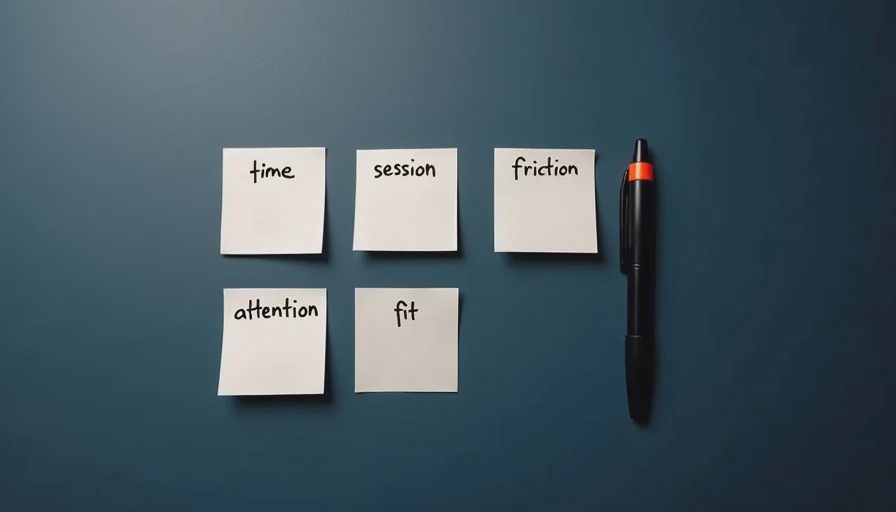
When I write about a game here, I try to cover five practical areas before I offer any broader judgment.
1. Time-to-Fun
How many hours (or sessions) until the game is regularly enjoyable rather than merely promising? This is the single most useful number for someone with five to seven free hours a week. A game that becomes excellent at hour fifteen is a different proposition from one that is already good at hour three.
2. Session Shape
What does a realistic 45–60 minute session feel like? Does it have natural stopping points? Does progress feel complete, or does it feel like I am constantly interrupting something larger? Games that only sing in long blocks get noted clearly.
3. Friction Points
Where does the game create unnecessary resistance? Long unskippable sequences, repetitive travel, inventory management that feels like work, systems that require frequent reference to menus or maps—these details determine whether a tired player keeps going or quietly drifts away.
4. Attention Demand
How much focus does the game actually require? Some titles remain enjoyable at 60% mental capacity. Others become frustrating or flat the moment attention slips. After a full workday that distinction is decisive.
5. Fit After the Novelty Fades
Once the initial impression has worn off—usually somewhere between hour six and hour twelve—what remains? Does the core loop still feel worth returning to, or does the game start relying on sunk cost and lingering curiosity to keep the player moving?
Only after those five points do I talk about the more conventional strengths: combat feel, world design, story, presentation. Those elements still matter. They simply sit downstream of the practical questions that protect limited time.
What I Deliberately Spend Less Time On
Graphics and technical spectacle receive less emphasis than they do in many other reviews. Not because they are irrelevant, but because they are already thoroughly covered elsewhere and rarely decide whether a game earns its place in my week.
I also avoid score theater. A single number collapses too many different variables into one false precision. A game can be a technical achievement and still be a poor use of my evenings. Another can look modest and still be an excellent fit. The format above keeps those realities visible instead of averaging them away.
Launch-day discourse and online controversy receive almost no attention. They move too fast and usually say more about the conversation than about the experience of playing the game in ordinary conditions.
How the Format Changes the Way I Play
Using this structure has altered my own habits. I now treat the first six to eight hours of any substantial game as an evaluation period rather than an automatic commitment. If the time-to-fun is slow, the session shape is awkward, or the friction is higher than expected, I give myself clean permission to stop. The hours already spent become useful data instead of a reason to continue out of loyalty.
The format also makes positive recommendations more trustworthy. When I say a game is worth playing, I can point to specific reasons that matter to someone with a similar schedule: early payoff, clean session rhythm, manageable attention demand, and a core loop that stays satisfying after the novelty drops. That is more useful to me than a general declaration that the game is “excellent.”
An Example of the Format in Practice
Consider two hypothetical games that both receive strong conventional reviews.
Game A looks stunning, has ambitious systems, and tells a critically praised story. Its time-to-fun sits around hour nine. Sessions feel best at two hours or more. Inventory and crafting create regular friction. Attention demand stays high. After the opening novelty, the loop becomes steady but rarely delightful. Under this format the recommendation would be cautious: impressive craft, moderate fit for limited or tired evenings.
Game B is smaller in scope and less visually spectacular. It is enjoyable by the end of the first session. Forty-five-minute blocks feel complete. Friction is low. It remains pleasant even when focus is only moderate. The core activity stays satisfying well past the initial impression. Under this format the recommendation is clearer: strong fit for the kind of time most of us actually have.
Both games can be “good.” Only one is likely to be a good use of a busy adult’s week. The format exists to keep that distinction visible.
Why This Matters for the Reviews You’ll See Here
Every No Regret Review on this site will lean on the same practical priorities. You will see clear notes on how long it takes for the game to become fun, what a realistic evening session feels like, where friction appears, how much attention is required, and whether the experience still holds up after the first rush of novelty.
You will see less emphasis on frame rates, ray tracing, or whether the game is a “generational leap.” Those details are easy to find elsewhere. What is harder to find is an honest accounting of how a game behaves inside the constrained, tired, start-and-stop reality of adult life.
The goal is not to be contrarian. The goal is to be useful. If a game is both well-made and a smart place to put limited evenings, I will say so directly. If it is well-made and still a questionable fit, I will say that too. The difference between those two outcomes is the entire point of the format.
Worth your time, or not?
That question is more precise than any graphics paragraph I have ever read. The review structure above is simply the long way of answering it.
—Grant
Comments
No comments yet — be the first to share a thought.